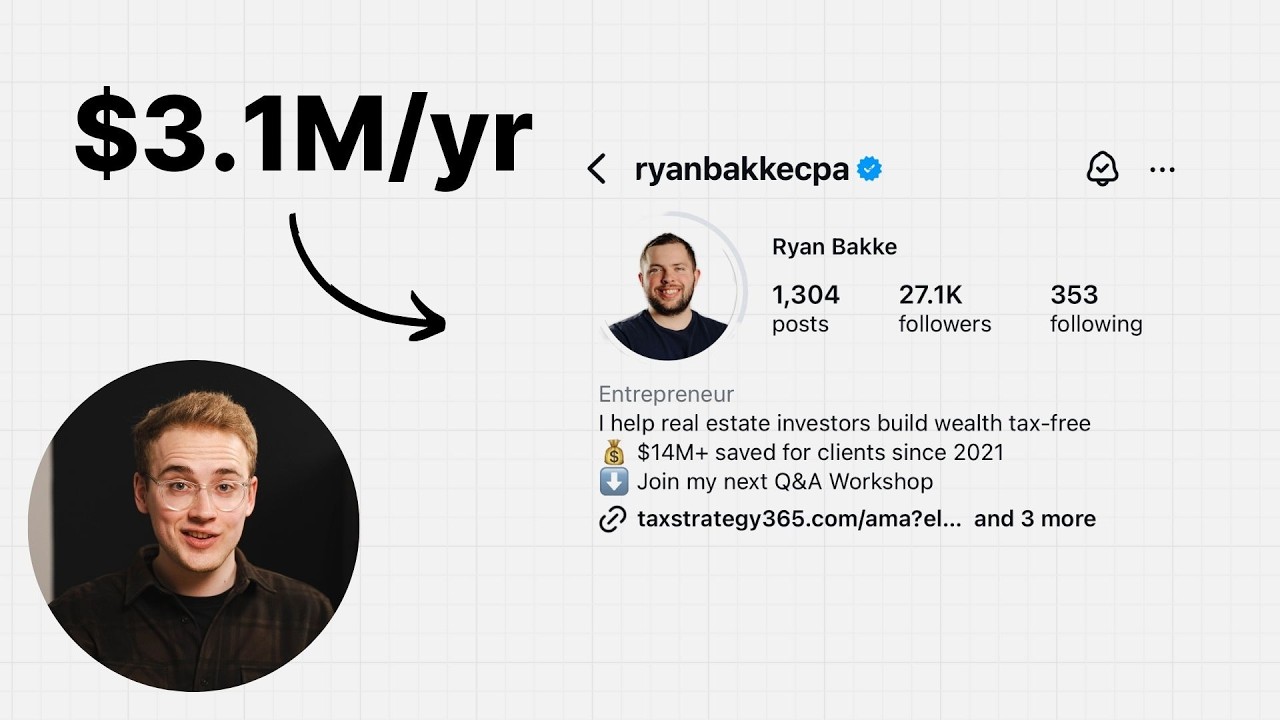
This Accountant Reveals How He Took Home $1M in Profit Last Year
Ryan Bakke was the very first client I ever signed at Social Club Studios. When we started working together, he was doing about $100,000 a year in his real estate CPA firm while still working a W-2 job. Fast forward two years: he grossed $1.7 million and took home roughly a million dollars in profit. With a seven-person team.
That is not a typo.
Here is exactly how it happened, and more importantly, what you can take from it and apply to your own firm.
From Hourly Billing to $5K Retainers
When Ryan and I first started working together, he was charging hourly for tax consulting. He made every pricing mistake in the book. Started at $80 an hour, climbed to $150, $250, $300, and eventually got all the way up to $500 an hour.
And at $500 an hour, most people would say that is incredible. But here is the math Ryan figured out: he would need ten separate one-hour calls with ten different people just to make $5,000. Or he could sell one person into a $5,000 annual retainer and make the same money from a single client.
The shift was from hourly consulting to a two-part productized offer: a $5,000 per year tax strategy retainer (which includes one-on-one calls, email access, private tools, templates, and weekly office hours) plus separate pricing for tax preparation and filing. Two distinct offers. No hourly billing. No friction between him and the client.
That friction piece is huge, right? When a client knows every phone call is going to generate a bill, they stop calling. They let questions pile up all year. Then at year-end, when you are trying to wrap everything up with a bow, those unanswered questions create massive headaches.
Borrowing Authority to Build Your Brand
Before Ryan ever ran a paid ad, he built his entire client base by leveraging other people’s audiences. Podcasts, webinars, Facebook groups, live events. He said yes to everything.
His philosophy is simple: pick a niche you genuinely care about, learn the language of that niche, and then go provide value on every platform where those people already gather. Ryan was an investor himself, so he could speak the language of real estate investing fluently. That is a massive differentiator. His prospects did not just want a CPA who understood the tax code. They wanted someone who could talk about what banks look for, what other investors are evaluating, and what the actual experience of owning rental properties feels like.
His first six-figure month came in December 2022 after appearing on a major real estate podcast. The leads from that single episode were so warm that the close rate was dramatically higher than anything else he had seen.
100 Leads a Month and What That Actually Means
Today, Ryan adds about 350 to 400 people per month to his email list. Of those, roughly 100 fill out an actual application form to work with his firm. These are not freebie downloaders. These are people who are raising their hand and saying, I want to talk to you about becoming a client.
Out of those 100 applications, about 85 book a call. His sales team closes around 27% at a $5,000 to $7,000 offer. That is 20 to 25 new clients a month.
And the tracking matters. Ryan can tell exactly where every lead comes from because every link is tagged. Facebook group leads, podcast listeners, Instagram followers, paid ads. He knows which source produces the warmest leads and the highest close rate. And without exception, the warmest leads are the ones who have consumed his long-form podcast content. Short-form social media grabs attention. Long-form content builds trust.
The Long Game That Everyone Else Refuses to Play
Here is something Ryan does that most firm owners do not: he plays the long game with leads who do not buy.
Out of those 85 sales calls per month, maybe 25 become clients. What happens to the other 60? They stay in the ecosystem. They get email sequences. They get retargeted. And a lot of them come back. Ryan has seen it over and over. Someone balks at the price in January, and by March they are back ready to sign.
He even described this scenario: because his systems are fast, he is often the first firm to reach out when someone fills out multiple applications. The prospect sees the price, says they need to shop around, talks to three or four other firms, realizes everyone is priced similarly but nobody else has the same level of systems and value, and comes back.
That speed to first contact matters, too. One of Ryan’s clients told him they signed specifically because the experience was so smooth. Application form, immediate calendar link, confirmation email, sales call the next day, signed within a week. That client said if the front end is this organized, the back end must be solid too.
The Team Behind $1.7M
Ryan runs this entire operation with a seven-person team: two virtual assistants, one full-time CPA, two contract CPAs, and two salespeople. That is it.
Earlier in his journey, he made the mistake of having CPAs take sales calls. Accountants learn technical expertise in school. They do not learn how to sell. Ryan invested $15,000 to $20,000 in sales coaching for himself, plus multiple six figures in ad spend that essentially doubled as sales training through sheer repetition. In 2022, he got on calls with 250 people who did not buy. In 2023, it was 350.
Every one of those was practice. And the lesson is clear: if your lead flow is strong enough, you can afford to learn through those missed opportunities. But eventually, you need dedicated salespeople so the founder can step back.
The Bottom Line
Ryan went from grinding 60 to 80 hour weeks and taking on any client who would pay him, to working 30 to 35 hours a week, running a lean seven-person team, and taking home a million dollars in profit on $1.7 million in revenue.
The core formula was straightforward: niche down into real estate tax strategy, shift from hourly to retainer pricing, borrow authority through other people’s platforms, build a marketing system that generates 100 qualified applications per month, and play the long game with every lead who enters the ecosystem.
If your firm is stuck at a plateau, the question to ask yourself is not whether you need more leads. It is whether the leads you are getting are high quality, whether your pricing reflects the value you provide, and whether you are playing a long enough game to capture the revenue that is sitting right in front of you.
Frequently Asked Questions
How did Ryan Bakke scale his accounting firm so quickly?
Ryan niched down into real estate tax strategy, shifted from hourly billing to a $5,000 annual retainer model, and invested heavily into consistent lead generation. He went from $100K part-time to $1.7M in about two years of full-time work. The combination of a specific niche, premium pricing, and relentless lead flow made the growth curve possible.
Why should accountants stop charging hourly?
Hourly billing creates friction between you and the client. Clients stop calling because they know every question costs money, and that leads to bigger headaches at year-end when everything piles up. A flat annual retainer removes that friction, lets you deliver better results throughout the year, and makes your revenue far more predictable.
How many leads does a successful accounting firm need per month?
Ryan generates about 100 qualified application forms per month, with roughly 85% of those booking a call. His sales team closes about 27% of booked calls at a $5,000 to $7,000 price point, resulting in 20 to 25 new clients monthly. Your numbers will vary based on your offer and price point, but the key is tracking every step of the process.
What is the best way for new accountants to get their first clients?
Borrow authority from established voices in your niche. Go on podcasts, answer questions in Facebook groups, and provide value to influencers and their audiences. Ryan built most of his early business this way before ever running paid ads. Pick a niche you care about, learn the language, and show up consistently where your ideal clients already gather.
How important is lead quality versus lead volume?
Lead quality matters far more than volume. If you fill your pipeline with low-quality leads, you will start to doubt your pricing and your offer. The real issue is you attracted the wrong people. Always prioritize quality over quantity. As Ryan put it, if you use the wrong bait, you will catch the wrong fish.
Want help scaling your firm?
If you're an accounting firm owner looking to build a predictable client acquisition system, let's talk.
Get in Touch
![How This Bookkeeper Scaled From $30k/mo → $92k/mo in 2025 [LIVE WORKSHOP RECORDING]](https://i.ytimg.com/vi/U6QCPbCaioE/maxresdefault.jpg)